Midjourney Unveils a Medical Scanner That Images the Whole Body via Ultrasound in 60 Seconds
Midjourney announced its medical division and the Ultrasonic CT device for full-body radiation-free ultrasound imaging, targeting 60 seconds, but the prototype takes 20 minutes with no FDA clearance.
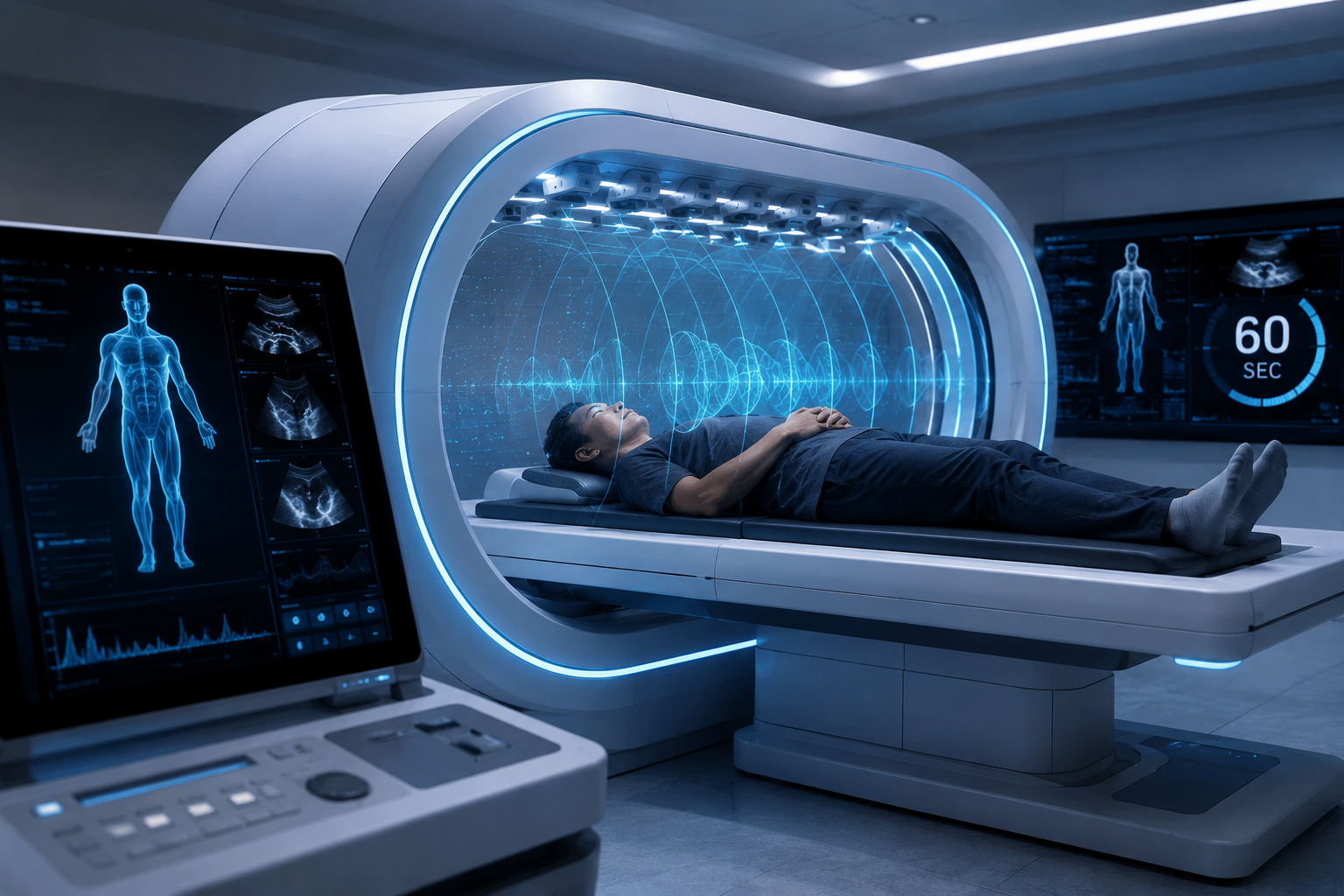
In a surprising turn far removed from what it is famous for, Midjourney, known for its AI image-generation tool, announced its entry into healthcare with its first-ever hardware product: a full-body scanner. On June 18, 2026, the company unveiled its new division, "Midjourney Medical," and the "Ultrasonic CT" device, which it aspires to scan the entire body in just 60 seconds, with no radiation and no magnetic fields.
How Does the Device Work?
The device's principle rests on a striking idea: a person stands on a platform that gradually lowers them into a pool of water at a rate of about five centimeters per second. As they descend, their body passes through a ring of submerged sensors that emit ultrasonic waves from every angle and record the returning echoes. Midjourney compares this process to dolphins using echolocation; as if the body were surrounded by thousands of tiny dolphins from every direction. These signals are assembled to form a 3D map of the body with accuracy down to fractions of a millimeter.
Not MRI and Not X-Ray
It is important to clarify the device's nature precisely. It is not a magnetic resonance imaging (MRI) machine nor X-ray imaging, but an entirely different technology relying on sound waves and water only. Midjourney says the resulting image quality is "similar to MRI scans" but, in ambition, at nearly a hundred times the speed, without any radiation or magnets. The most notable paradox is that the device does not use generative AI at all, the very technology that made Midjourney famous; its image-formation pipeline has nothing to do with AI image generation.
The Foundation: A License From Butterfly Network
Midjourney is not building this technology from scratch, but relying on a co-development and licensing agreement it signed in November 2025 with Butterfly Network, a company specializing in semiconductor-chip-based ultrasound devices. Under the agreement, Midjourney obtained an exclusive license, within a specified field of use, to "ultrasound-on-chip" technology. The scanning ring is thus built on thousands of transmit-and-receive elements based on Butterfly's chips.
Reality vs. Ambition: A Gap to Note
Here the importance of distinguishing between what has actually been accomplished and what is a future goal emerges. The "60 seconds" figure that led the announcement is the ultimate ambition, while the current prototype takes about 20 minutes per scan, has been tested on only about a dozen people, and carries no clearance from the US Food and Drug Administration (FDA) to diagnose any condition. The team involved is also small (about nine people) and has never built or operated a regulated medical device. The fundamental question, as analysts note, is not whether the physics works (it does), but whether this team can bridge the large gap between a promising prototype and an approved, commercially deployed medical device.
The "Scan as a Spa Visit" Vision
Midjourney is not stopping at the device, but building an entire experience around it. It plans to open a "Midjourney Spa" in the heart of San Francisco by the end of 2027, where the scan would be a calm, pleasant experience closer to a resort visit than a radiology clinic. The company's long-term ambition is striking: deploying more than 50,000 scanners around the world over the coming years, to perform nearly a billion full-body scans per month by 2031. Notably, Midjourney describes itself as a community-backed research lab with no outside investors, and says it will fund the first spa itself.
Conclusion
Midjourney's announcement is bold and exciting, presenting an ambitious vision to make medical imaging "available whenever you want" and at a low cost. But the gap between vision and reality remains vast: a slow prototype, limited testing, and a long regulatory road ahead before the FDA. The physics is genuinely promising, but history is full of promising medical devices that stumbled between the lab and the market. The news deserves to be followed with both enthusiasm and caution, remembering that what was announced today is the start of a long journey, not a finished product.
Newsletter
Enjoyed this?
Subscribe and get every new article and news post straight to your inbox.