Kimi K3: China Releases the World's Largest Open-Weight Model at 2.8 Trillion Parameters
Moonshot AI released Kimi K3 with 2.8 trillion parameters and a one-million-token context, making it the world's largest open-weight model. The architecture, the conflicting claims, the surprising price, and the stated limits.

Eighteen months ago, China's Moonshot AI was losing ground after DeepSeek's meteoric rise. This week, it released a model that shook the industry: Kimi K3, with 2.8 trillion parameters, making it the world's largest open-weight model — roughly 75% larger than DeepSeek V4 Pro. With a one-million-token context window, native vision, and performance the company says rivals the most powerful proprietary models, the launch landed just ahead of the World Artificial Intelligence Conference in Shanghai. But behind the shiny numbers are details worth scrutinizing.
What Is Kimi K3 Technically?
K3 is a sparse Mixture-of-Experts (MoE) model built on two architectural innovations Moonshot developed internally and previously published as open research. The first is Kimi Delta Attention (KDA), a hybrid linear attention mechanism the company says enables up to 6.3x faster decoding in million-token contexts. The second is Attention Residuals (AttnRes), which works along the depth axis and delivers — per the company — about 25% higher training efficiency at under 2% additional cost. The sparsity reaches a striking level: activating only 16 experts out of 896. The model ships with an always-on reasoning mode the company calls "thinking mode," and is compatible with the OpenAI SDK, lowering the integration barrier for those already building on OpenAI or Anthropic tooling.
The Claims: Two Narratives Worth Distinguishing
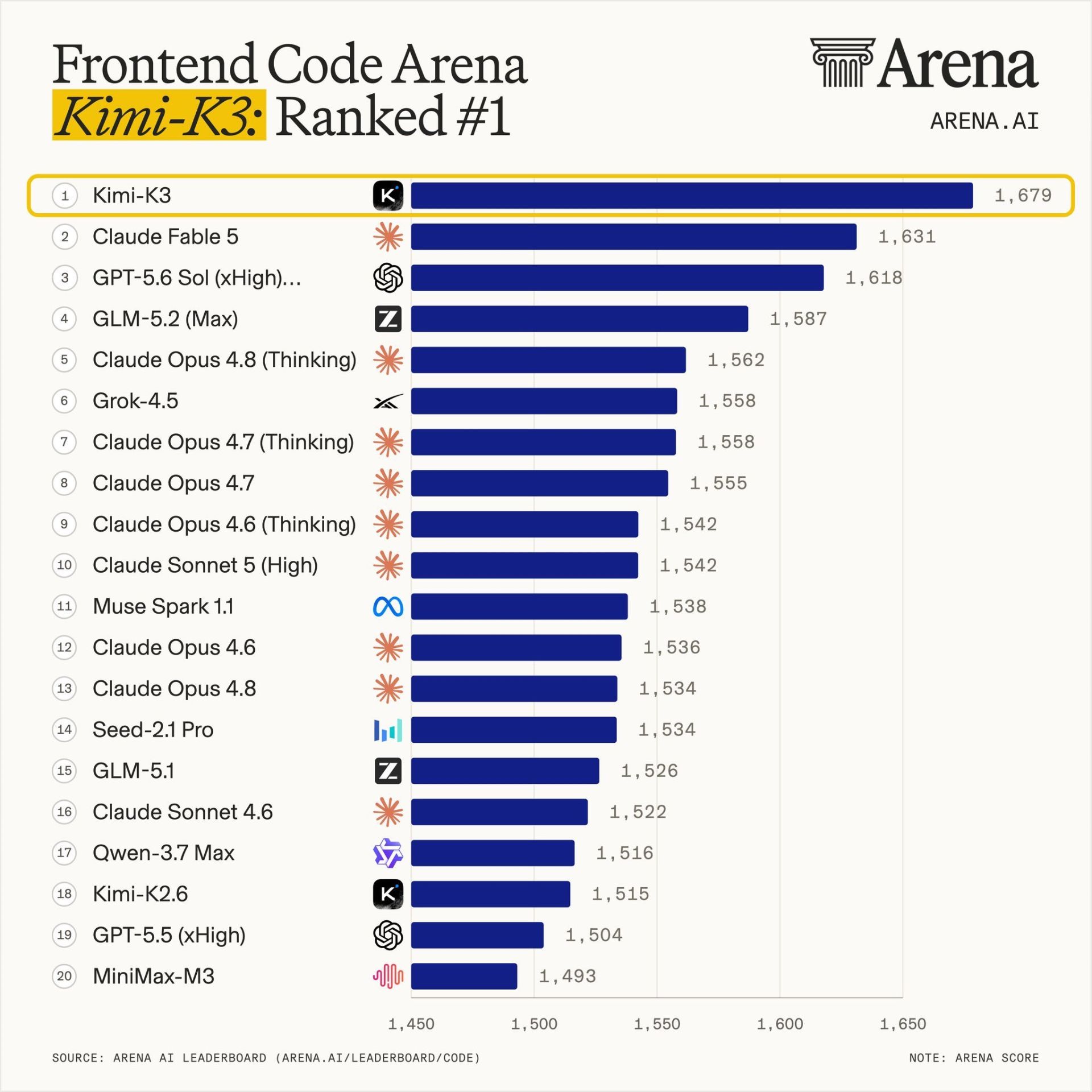
Here is a point needing precision, as the company's own phrasings conflict. In its press release, Moonshot described K3's performance as "competitive" with Claude Fable 5, and said it "substantially outperformed" Claude Opus 4.8, GPT 5.6 Sol, and GPT 5.5, calling it its most powerful open-source coding model, capable of sustaining long engineering sessions and navigating massive repositories with minimal human oversight. Yet the company itself acknowledged, per CNBC, that K3 "still trails" Fable 5 and GPT 5.6 Sol on overall performance, even as it consistently outperformed the other tested models. The honest summary: on the company's official benchmarks, K3 ranks within the top three models, but a noticeable gap in user experience remains against the two leaders.
An Independent Signal... and a Necessary Caveat
The strongest signal did not come from the company: in blind testing by the evaluation platform Arena, developers preferred Kimi over every leading US model — a notable result because it comes from a neutral party. But the caveat Axios stressed is fundamental: the model has been available for only hours, and early benchmarks and viral demonstrations may overstate its reliability in real-world work. More importantly: the weights have not been released yet; they are due July 27. That is, developers cannot yet inspect or run the model themselves — so calling it "open" is accurate as a promise, not as today's reality.
The Surprise: Not Cheap as Usual
Contrary to the stereotype about Chinese models, K3 does not come at a steep discount. Its price of about $12 per million tokens places it closer to Anthropic's mid-tier than to the deep discounts Moonshot's earlier releases were known for. This is an important point for anyone evaluating cost: the argument for K3 here is not price, but capability plus the option of owning the weights later.
Limits the Developer Itself Acknowledges
In fairness, it is worth relaying the constraints Moonshot states explicitly. The model is sensitive to thinking history: switching sessions or using incompatible agent harnesses may cause unstable generation. It may also make unexpected autonomous decisions during task execution — a serious warning for anyone considering running it as an agent in production. So the company itself recommends explicit behavioral constraints for production use.
The Bigger Context: The Timing Is No Coincidence
Moonshot is one of China's "Six AI Tigers," founded in March 2023 by Tsinghua University classmates, with no more than 300 employees, about 36% owned by Alibaba, and considering a Hong Kong IPO. The launch timing just before the Shanghai conference — where President Xi Jinping is expected to lay out Beijing's AI priorities — is no coincidence. DeepSeek is expected to release an update soon, raising the prospect of two consecutive Chinese breakthroughs.
This news connects directly to what we previously tracked regarding the rising share of Chinese models in US companies' token consumption. But the practical lesson for teams is not "switch your model today," but what recurs with every launch: a developer's own data is not a neutral evaluation, and real performance shows up in your tasks, not on leaderboards. Wait for the weights on July 27 and independent evaluations, then measure against your actual use cases (latency, reliability, error rate) before any decision. And whoever built an "abstraction layer" allowing easy model swapping will evaluate K3 in a week rather than rebuilding their application. (Disclosure: this news compares against models from Anthropic, the maker of Claude, and is presented objectively with each claim attributed to its source.)
Newsletter
Enjoyed this?
Subscribe and get every new article and news post straight to your inbox.